 Get yours today!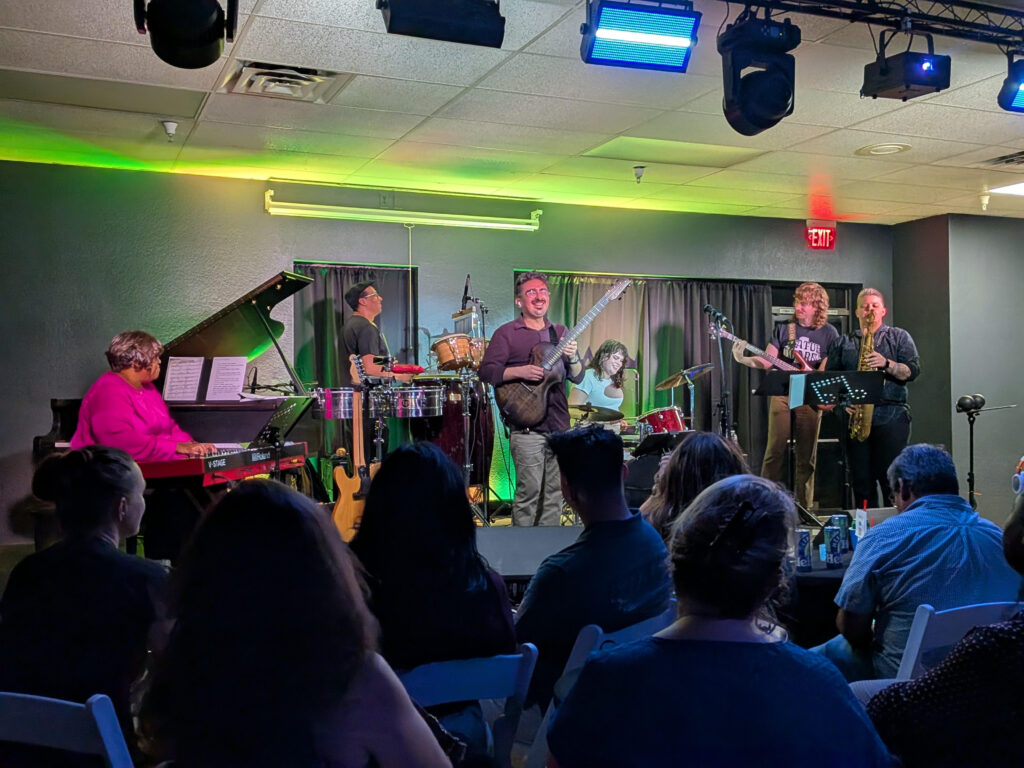
This Saturday, something special happens at Phoenix Conservatory of Music.
The teachers step onto the stage.
At our PCM Faculty Concert, the musicians who spend their weeks encouraging students to practice, take risks, try again, listen closely, collaborate, and perform with confidence will become the performers themselves.
It is going to be a wonderful concert. But it also represents something much bigger about how we think music education should work.
At PCM, our teaching artists are not simply instructors delivering lessons. They are working musicians, educators, mentors, and role models who help young people understand what it means to grow as an artist.
And as PCM looks toward the future, investing in these educators is one of the most important investments we can make.
Students Need to See What Is Possible
There is something powerful about watching your teacher perform.
Suddenly, the person who asks you to practice is practicing, too.
The person who encourages you to take a creative risk is willing to take one in front of an audience.
The person who tells you that musicians never stop learning demonstrates exactly what that means.
That matters because young people need more than instruction. They need examples.
PCM students learn technique, theory, songwriting, audio production, ensemble skills and performance. But along the way, they are also learning persistence, communication, collaboration, leadership and how to respond when something does not go exactly as planned.
Our teaching artists model those lessons every day.
A Great Music Program Is Really a Community of People
It can be tempting to think about access to music education primarily in terms of tuition.
Affordability absolutely matters. Scholarships and financial aid matter. Instruments matter.
But true access requires something more.
A student can only benefit from a scholarship if there is an excellent educator ready to teach them. A young musician can only move from a first lesson toward an ensemble, recording studio, college program or career if there are knowledgeable adults helping them navigate that journey.
That is why one of PCM’s strategic priorities is strengthening the entire pathway surrounding our students—including investing in the people who make that pathway possible.
We are working toward stronger professional development for our teaching artists, more consistent curriculum and assessment, improved technology and systems, competitive compensation, and opportunities for educators to remain active and growing artists themselves.
Some of those investments happen behind the scenes.
Students experience them every day.
From a First Lesson to a Future We Cannot Yet Imagine
This month’s newsletter also introduces our community to PCM alum Amaya Lim.
As a teenager, Amaya spent Saturdays at PCM studying guitar, voice and theory and playing in ensembles. Today, she is combining music, technology and entrepreneurship as the founder of Turntable, an online music community designed to help people discover and share music across streaming platforms.
Her path is uniquely hers—and that is exactly the point.
We cannot know when a young person walks through our doors whether they will become a performer, songwriter, producer, music educator, engineer, entrepreneur, arts supporter—or choose a career completely outside music while carrying the confidence and creativity they developed here.
Our responsibility is not to decide the destination for them.
It is to give them excellent instruction, meaningful relationships, opportunities to explore and enough pathways that they can begin discovering it for themselves.
Amaya has described PCM as giving her something she did not find elsewhere growing up: a community of people who loved music and adults who took young musicians seriously.
That is the kind of environment we want every PCM student to experience.
And teaching artists are essential to creating it.
Building the PCM of the Future
As PCM grows, we are asking an important question:
What needs to become stronger so that we can serve more young people—and serve them well?
Part of the answer is infrastructure. Part is technology. Part is curriculum, instruments, scholarships, facilities and partnerships.
But at the center are people.
Excellent music education requires excellent educators who have the resources, compensation, professional development and organizational support they need to stay, grow and create.
That is not separate from student access.
It is how we sustain it.
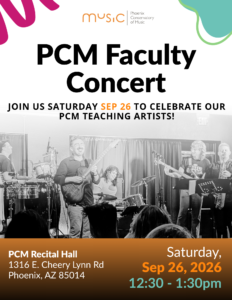
So when our faculty members take the stage this Saturday, we are celebrating more than their considerable musical talent.
We are celebrating the artists who teach our artists.
The mentors who help a beginner play that first uncertain note.
The educators who recognize potential before a student can always see it themselves.
And the musicians who remind all of us that becoming an artist is not a destination. It is a lifelong practice of listening, learning, creating and sharing.
That is the community we are building at PCM.
And because of music—and because of you—we can keep building it together.
Join us for the PCM Faculty Concert
Saturday, September 26, 2026
12:30–1:30 PM
Phoenix Conservatory of Music
1316 E. Cheery Lynn Road, Phoenix, AZ 85014